Read in 8 mins
How to Find Interior Design Ideas That Actually Work for Your Space
A good design idea should help you make practical decisions about your space, not just give you something beautiful to look at. Before choosing products, materials, furniture, and professionals, you need to understand how an idea fits your room, lifestyle, budget, and project requirements.
Key Takeaways at a Glance
Core Insight: Choose interior ideas based on your actual room, daily requirements, and design direction rather than appearance alone.
Cost Factor: A practical design helps you avoid spending on products that do not fit your space or work with the rest of the interior.
Efficiency Tip: Keeping inspiration, visualization, products, and professional requirements connected can reduce unnecessary searching and repeated decisions.
How to Find Interior Design Ideas That Fit Your Space
1. Start With Your Space
The most important thing is the space you are dealing with. After placing all your furniture and decorative elements, there should also be enough space to move around so that you don’t feel suffocated.
Note your room’s length and width, ceiling height, doors, windows, natural light, existing flooring, electrical points, and fixed elements. For a new home, start with the floor plan and understand how each space connects to the others.
Then consider how you actually use the room.
For example, a living room should allow comfortable family gatherings, television viewing, storage, and occasional work. A bedroom needs enough space for a wardrobe, dressing area, study corner, and easy movement around the bed. In the kitchen, the layout should support cooking, storage, appliances, cleaning, and smooth movement between different work areas.
These requirements should influence the type of design ideas you save.
2. Identify What You Actually Like
If you are unsure about your style, do not force yourself to choose a label immediately.
Instead, collect a small set of interiors that appeal to you and look for patterns.
Notice which features you repeatedly choose, such as warm wood, neutral colours, simple furniture, traditional details, open spaces, bold lighting, or textured walls.
Your repeated choices are often more useful than a style name and naturally point you to what would suit your space.
Create separate references for:
Colours and finishes
Furniture
Flooring
Walls
Ceilings
Lighting
Storage
Kitchen details
Decorative elements
Our ‘Ideas’ section can support this discovery stage by helping you explore complete design directions rather than searching for disconnected products from the beginning.
3. Separate Inspiration From What You Can Actually Recreate
An inspiration image should be treated as a reference, not a specification.
Let’s say you see a picture or post of a living room with a large sectional sofa. Before looking for the same sofa, check whether your room has enough width for it while still leaving comfortable circulation.
The same applies to the kitchen. A photograph you see online might show a clean countertop because appliances and storage requirements are hidden from view. But in reality, your kitchen would need significantly more functional storage.
The objective is to take the design idea and adapt it to your circumstances.
4. Visualize the Direction Before Making Major Decisions
Sometimes it is difficult to understand whether a style will work until you see it in the context of your own room.
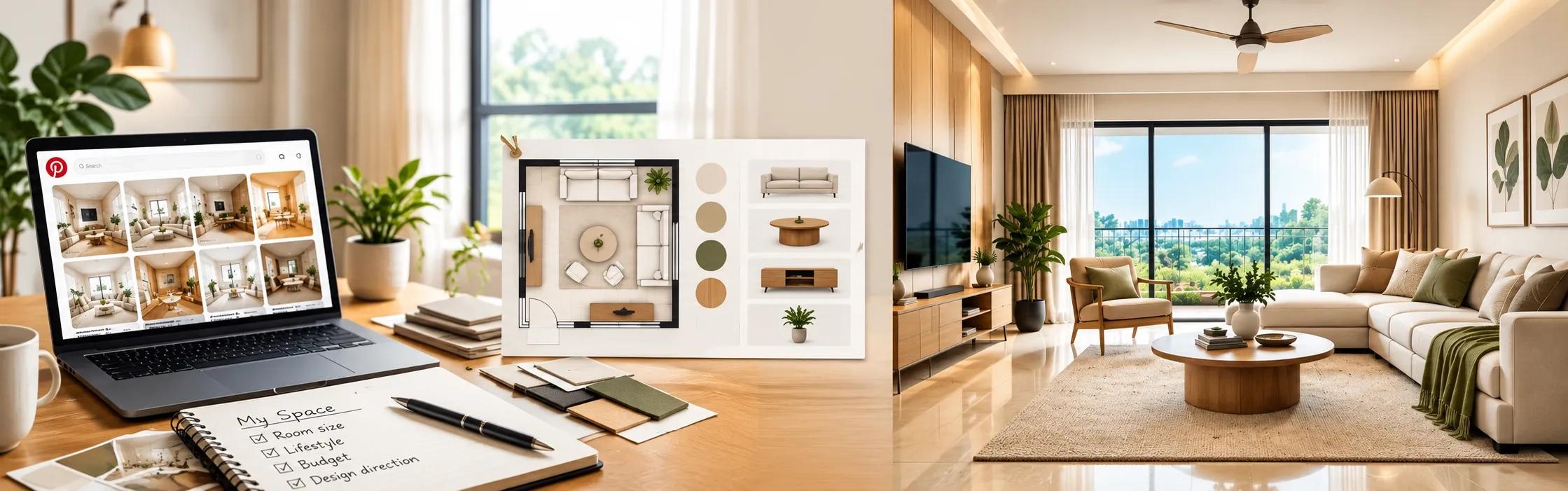
This is where visualization can make the planning process more useful. With simple applications, you can imagine how a generic room might look, and you can explore different directions using your existing space as a reference.
With StudioWorld, we provide a way to explore interior concepts from a space you are working with. You can experiment with different directions, including luxury, minimalist, and Indian traditional styles, and use those visual references to guide your next decisions.
5. Looking Beyond Appearance
Once you find an interior idea you like, run it through a practical filter.
Interior Planning Checklist
Check room dimensions and layout suitability.
Ensure the layout supports everyday use.
Consider natural light, colours and finishes.
Choose materials based on durability and maintenance.
Confirm furniture fit and storage needs.
Check product availability against your budget.
Identify any changes needed before installation.
This is where a beautiful reference becomes a usable design direction.
Planning an Interior: Inspiration vs. Practical Choices
Consideration | Inspiration-Only Approach | Space-Ready Approach |
Room size | Copies the look | Adapts the design to available space |
Furniture | Selected for appearance | Checked for size, use, and movement |
Colours | Chosen from the image | Considered with natural and artificial light |
Materials | Selected for visual appeal | Considered for use, maintenance, and installation |
Storage | Often overlooked | Planned around actual requirements |
Products | Bought individually | Shortlisted as part of one design |
Budget | Considered after selection | Used to guide choices from the start |
The second approach does not mean giving up the look you love. It means understanding what makes that look work and adapting those elements to your own home.
Build Your Shortlist Before You Build Your Shopping List
Once your design direction is clear, use this checklist to organize what you need for each room:
Product Shortlist Checklist
1. List products by room
☐ Living room: flooring, wall finishes, seating, tables, lighting, storage, curtains, décor
☐ Bedroom: flooring, bed, wardrobe, lighting, storage, wall treatment, furniture
☐ Kitchen: cabinets, countertop, hardware, appliances, lighting, fixtures
2. Check each product for
☐ Size and space fit
☐ Material and finish
☐ Durability
☐ Maintenance requirements
☐ Installation requirements
☐ Availability
☐ Budget
3. Shortlist before finalizing
☐ Keep multiple suitable options
☐ Compare products against your space and overall design
☐ Avoid making every purchase decision at once
☐ Keep your shortlist aligned with the original design direction
4. Keep inspiration and product discovery connected
☐ Refer back to your design ideas
☐ Explore products that match the look and requirements
☐ Narrow down suitable options before moving toward purchase or sourcing
This approach keeps your product research organized without losing sight of the interior you are trying to create.
Sourcing and Vendor Coordination Matter Too
A design can be well planned and still become difficult to execute if sourcing is fragmented.
Product & Supplier Selection Checklist
Before selecting a product or supplier, check:
☐ Manufacturer information
☐ Product specifications
☐ Material and finish details
☐ Product availability
☐ Expected lead time
☐ Suitability for your intended application
☐ Delivery schedule
☐ Delivery sequence for products needed at different project stages
☐ Coordination between multiple suppliers, where required
For larger projects, make sure the delivery schedule matches your project timeline so materials arrive when they are actually needed.
If you are working with an interior designer, architect, contractor, or builder, keep these requirements visible to everyone involved. A product decision made without considering installation or project timing can create delays later.
We bring products, brands, dealers, and professionals into a connected discovery environment, helping reduce the gap between what you want to create and what you need to source to create it.
Professional Tips for Architects and Interior Designers
For professionals, a client's collection of interior references can be a useful starting point, but it should not automatically become the project specification.
Look for the design principles behind the references. Identify recurring colours, materials, proportions, furniture styles, lighting approaches, and different preferences. Then translate those preferences into decisions that suit the project's dimensions, function, budget, and execution requirements.
It is equally important to distinguish between a visual reference and an actual product requirement. A client may like the appearance of a particular stone, wood finish, light, or furniture piece without knowing its maintenance, availability, installation requirements, or cost.
We bring this entire journey together through Ideas, StudioWorld, Products, and Professionals, so you can move from finding inspiration to exploring designs, discovering products, and connecting with the right people for your project.
Streamline the Journey From Ideas to Execution
Finding interior design ideas is easy. Finding ideas that fit your space requires a more deliberate process.
Think of it as a simple process: understand your space, define how you use it, identify the design elements you like, explore those ideas in your actual room, shortlist the right products, and bring in professional support when needed.
That is the journey we are building at BuildingWorld:
Ideas → StudioWorld → Products → Professionals
Instead of treating inspiration, visualization, sourcing, and professional discovery as completely separate activities, we bring them closer together so your decisions can remain connected.
Find Interior Design Ideas That Work for Your Home
A good interior starts with more than a style you like. It needs to fit the way you live, the space you have, and the choices you will eventually make. Once you understand these things, it becomes easier to shape inspiration into something that works for your home.
With BuildingWorld, you can explore Ideas, develop visual directions with StudioWorld, find Products that suit your plan, and discover Professionals when you need help taking the project forward.
So instead of collecting more inspiration, start by understanding your own space and build from there.
Explore your interior possibilities and take the next step with BuildingWorld.